Ion Voicu was one of the greatest Romanian violinists of the 20th century. Born into a family of Roma musicians, he was a pupil of George Enescu and gave hundreds of concerts on every continent.
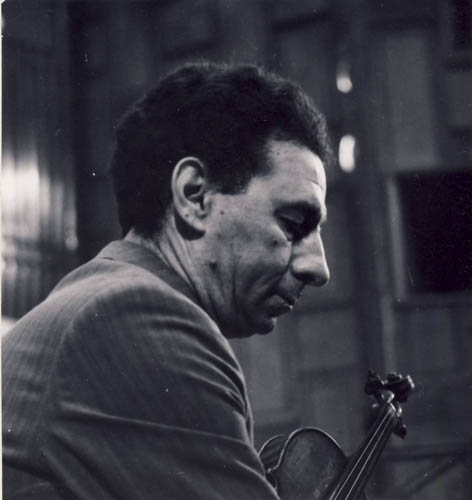
Source: Wikimedia Commons
Key moments in his life
- 8 October 1923 – born in Bucharest, into a family of Roma musicians. His grandfather was a cellist, and his father played violin and double bass. His brothers also became musicians.
- At 6 years old he begins studying the violin. At 14 he is admitted to the Royal Academy of Music directly into the fourth year and completes the seven-year course in only three, in 1940.
- He becomes a soloist of the National Radio Orchestra after the Dutch conductor Willem Mengelberg hears him play Bach, Beethoven and Mendelssohn. His talent impresses George Enescu, who gives him free lessons.
- 1946 – wins first place at the competition organised in Bucharest by Yehudi Menuhin.
- 1956 – the Romanian state entrusts him with a 1702 Stradivarius violin that had belonged to Joseph Joachim.
- In 50 years of career he plays in Paris, New York, London, Rome, Vienna, Tokyo and Berlin, alongside Yehudi Menuhin, David Oistrakh and Leonid Kogan.
- 1964 – receives the title People’s Artist. For ten years he is director of the “George Enescu” Philharmonic in Bucharest.
- 1969 – helps create the Bucharest Chamber Orchestra, led today by his son, Mădălin Voicu.
- 24 February 1997 – dies in Bucharest.
Artistic activity
Over 100 records and CDs preserve his performances. His repertoire included both the great classical concertos and forgotten works brought back to life, as well as new pieces written especially for him by Romanian and foreign composers.
Legacy
Ion Voicu remains a symbol of the Romanian violin school and proof of the contribution of Roma musicians to great classical music. In Bucharest, a park bears his name, and the Chamber Orchestra he founded continues his tradition.
Sources
- Ion Voicu – Wikipedia (ro)
- Ion Voicu – Wikipedia (en)
- Image: Wikimedia Commons (attribution licence)